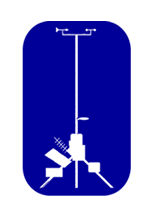
Arctic areas of Alaska are especially vulnerable to nuclear accidents releasing radioactivity into the atmosphere within the circumpolar north. Atmospheric fallout and the resultant bioconcentration in the lichen-caribou-human food chain are of great concern for those living a subsistence lifestyle. A project, Observing Radiation In Our North (ORION), formally known as Neighborhood Environmental Watch Network (NEWNET), was initiated to provide an opportunity for Alaska Native undergraduate college students to participate in environmental monitoring, research, and communication of the results through the American Indian Science and Engineering Society (AISES) at the University of Alaska Fairbanks.
ORION is a network of stations that gather both meteorological and radiological data. Originally, the data was transmitted via the GOES West satellite to the Los Alamos National Laboratory in Los Alamos, New Mexico. The data was loaded into a database that can still be accessed by the public via the internet at http://newnet.lanl.gov. Currently, ORION is a stand-alone system in Alaska.
Long-term meteorological and radiation observations are providing a baseline against which any major changes in atmospheric conditions and radioactivity can be detected. For example, the former Soviet Union has many old and outdated nuclear facilities still in operation. The Bilibino nuclear facility which is the closest to Alaska is one such aging plant that could accidentally release atmospheric radiation. ORION stations gather real time data and would detect any increase in background radiation levels should such an accident occur or should any other sources release radiation into the Alaskan atmosphere.
Historically, ORION (NEWNET) stations in Alaska were located in Kotzebue, Nome, Point Hope, Barrow, Seward, and Fairbanks. Now, ORION has stations in Nome, Barrow, and Fairbanks.
ORION is a collaborative effort with Battelle-Pacific Northwest National Laboratory (PNNL), Alaska Department of Environmental Conservation (ADEC), the Environmental Protection Agency's RadNet program, and various organizations and departments of the University of Alaska Fairbanks.
Realtime and archived data from ORION Project monitoring stations is available at http://www.orion-uaf.org
 |
 |
 |
 |
 |
 |
 |
Last Revised: December 11, 2009